Material Handling Equipment Field Notes: Manual Pallet Jack Lift, Hand Scissor Lift & Hydraulic Lift Tables in Real Warehouse Operations
In most warehouse and factory projects, equipment is not selected based on product catalogs. It is selected after repeated operational failures such as slow handling speed, worker fatigue, inconsistent lifting height, or workflow congestion at specific stations.
The following content is structured more like an internal engineering record from real warehouse optimization cases, focusing on how Manual Pallet Jack Lift, Hand Scissor Lift, and Hydraulic Lift Tables are actually introduced into operations—not how they are described in brochures.
Case 1: “We only needed to move pallets, but lifting became the real bottleneck”
Initial situation
A medium-sized warehouse was originally designed for basic pallet storage and manual transport. The system included standard pallet trucks and occasional forklift use.
However, after order volume increased:
- Workers were manually lifting pallets onto workbenches
- Loading height differences slowed down packaging
- Forklifts were overused for small lifting adjustments
- Labor fatigue increased during peak shifts
At this stage, management initially thought the problem was transport speed.
But field observation showed something different:
70% of delay was not transport — it was lifting and repositioning.
Equipment introduced: Manual Pallet Jack Lift
The first change was introducing Manual Pallet Jack Lift units at receiving and staging zones.
Their role was not replacement, but redistribution of workload:
- Forklifts stopped handling small pallet movements
- Manual pallet jack lift handled short-distance repositioning
- Operators no longer dragged or manually adjusted pallet positions
Real improvement observed:
- Reduced forklift idle time
- Faster dock-to-staging transfer
- Lower operator physical strain
However, another issue remained unsolved: workstation height mismatch.
Case 2: “Workers were still bending too much during processing”
New problem after initial upgrade
Even after improving pallet movement, production efficiency did not fully improve.
The issue shifted to workstation operations:
- Workers bending to pick materials repeatedly
- Cartons placed at inconsistent heights
- Packaging speed slowed due to posture fatigue
- Quality inconsistency during long shifts
This is a very common hidden inefficiency in warehouse environments.
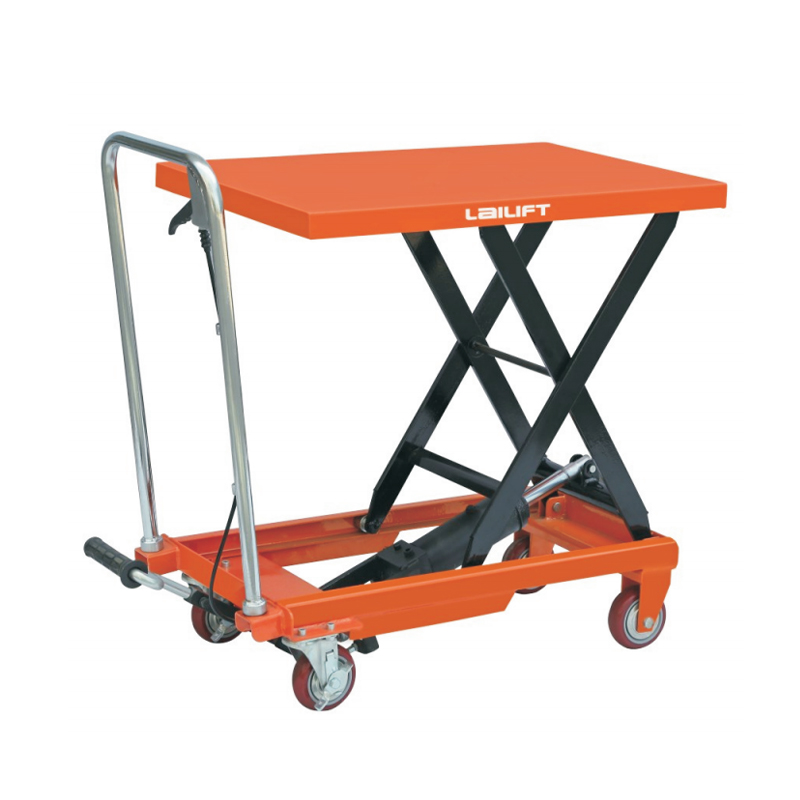
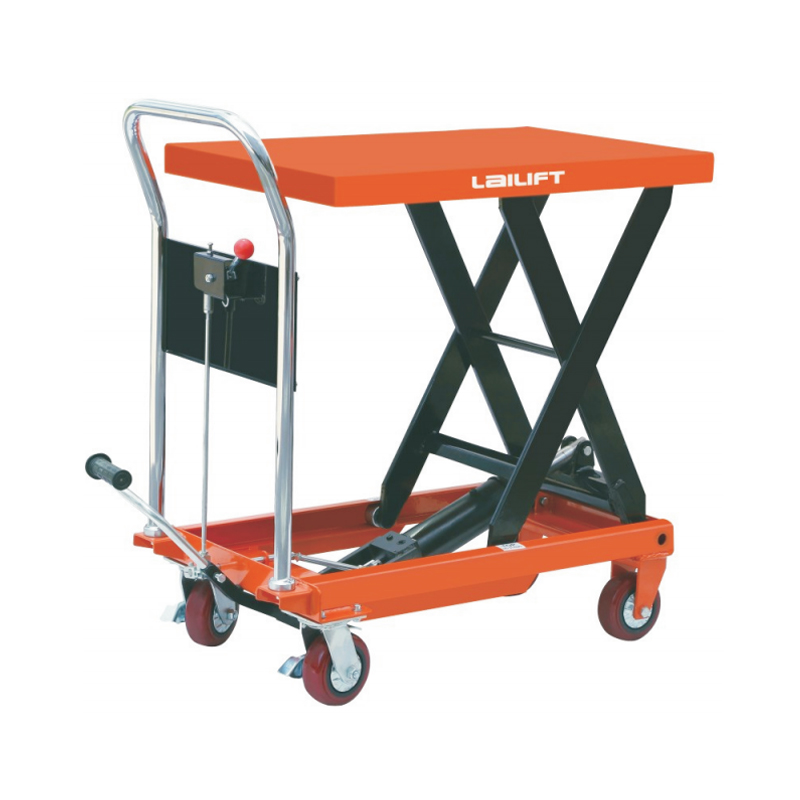
Equipment introduced: Hand Scissor Lift
A Hand Scissor Lift was installed at packaging and sorting stations.
Instead of redesigning the entire warehouse, the solution was simple:
adjust material height to the worker, not the worker to the material.
Operational change:
Before:
- Workers bend → lift → sort → repeat
After:
- Load placed on scissor lift
- Height adjusted to waist level
- Continuous sorting without posture change
Measured outcome in real operation:
- Reduced repetitive bending cycles
- Faster packaging throughput per worker
- Lower injury risk in peak operations
This was the first time the warehouse saw improvement not in transport speed—but in workstation ergonomics.
Case 3: “We still had unstable lifting at different production stations”
New bottleneck
As production expanded, multiple stations required different working heights:
- Assembly line A required low-height access
- Inspection table required mid-height positioning
- Packaging area required adjustable elevation
Fixed-height tables were not flexible enough.
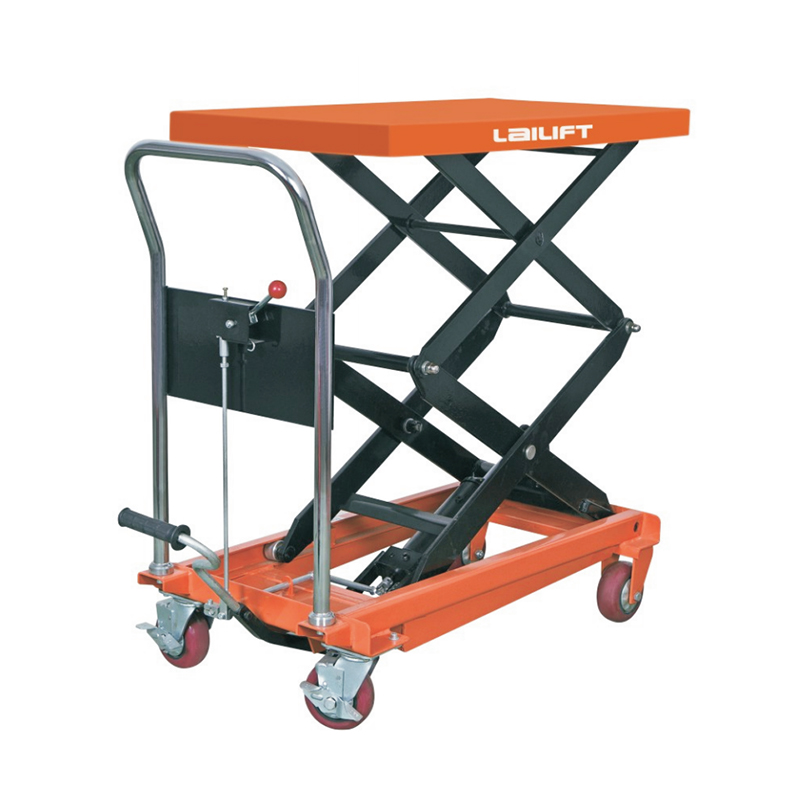
Equipment introduced: Hydraulic Lift Tables
Hydraulic lift tables were deployed as station-level infrastructure, not mobile equipment.
Why this mattered:
Unlike manual lifting tools, hydraulic lift tables provided:
- Stable load positioning
- Controlled vertical movement
- Repeatable height settings for production consistency
Real factory usage pattern:
- Raw material placed on table
- Lifted to optimal working height
- Assembly or inspection performed
- Lowered and transferred out
This created a controlled micro-workstation inside the warehouse.
System-Level Insight: Why These Three Equipment Types Work Together
After all upgrades, the warehouse did not rely on one single solution. Instead, a layered system was formed:
1. Manual Pallet Jack Lift → Flow control layer
- Handles short-distance transport
- Reduces forklift dependency
- Keeps material flow continuous
2. Hand Scissor Lift → Ergonomic adjustment layer
- Solves height mismatch
- Improves operator comfort
- Reduces repetitive strain
3. Hydraulic Lift Tables → Station control layer
- Stabilizes production workstations
- Standardizes height across processes
- Improves consistency and quality
Together, they form a non-automated but highly structured material handling system.
Why Many Factories Still Prefer Manual + Hydraulic Systems
Despite the availability of electric forklifts and automated conveyors, many factories continue using these systems because:
- They can be deployed without redesigning warehouse layout
- They require no charging infrastructure or complex maintenance
- They adapt easily to changing production requirements
- They are cost-effective for medium-load operations
- They solve localized bottlenecks instead of replacing entire systems
In real industrial upgrades, these tools are often the first step before automation investment, not the final stage.
Procurement Insight: How Buyers Actually Evaluate These Products
From real B2B procurement behavior, buyers rarely start with product names like “lift table” or “scissor lift”.
They usually start with problems such as:
- “workers are bending too much”
- “pallets are too low for packing”
- “forklifts are too expensive for small tasks”
- “loading takes too long at dock area”
Then they map solutions:
- Manual Pallet Jack Lift → transport inefficiency
- Hand Scissor Lift → workstation fatigue
- Hydraulic Lift Tables → production inconsistency
This is why successful B2B pages should match problem language, not product language.
Real Performance Expectations (Based on Field Use)
In practical warehouse environments, improvements are usually not dramatic individually, but cumulative:
- Transport time reduced at dock zones
- Worker fatigue significantly decreased
- Packaging speed stabilized across shifts
- Equipment utilization balanced across departments
The key insight from multiple warehouse cases is:
Efficiency gain does not come from replacing equipment — it comes from removing repeated micro-delays.
Conclusion: These Systems Are Not Equipment, They Are Workflow Fixes
Manual Pallet Jack Lift, Hand Scissor Lift, and Hydraulic Lift Tables are often misunderstood as simple mechanical tools.
In real industrial environments, they function as:
- Flow stabilizers (transport layer)
- Ergonomic correctors (workstation layer)
- Process standardizers (production layer)
When combined correctly, they do not just move materials—they restructure how work happens inside a warehouse.
For B2B operations, their real value is not specification-based, but workflow-based efficiency improvement under real operating conditions.

 English
 русский
 Español
 عربى
عربى
 Português