Field Application Report: Electric Walkie Stacker Forklift & Walkie Counterbalance Forklifts in Warehouse Optimization Projects
In most warehouse upgrade projects, the decision to introduce Electric Walkie Stacker Forklift or Walkie Counterbalance Forklifts does not come from product selection catalogs.
It usually starts with operational breakdowns such as:
- Forklifts occupying too much space in narrow aisles
- Manual pallet movement becoming too slow for order volume
- Vertical storage not being fully utilized
- Internal transport delays between warehouse zones
- Operator fatigue during repetitive short-cycle handling
This document summarizes how these two types of equipment are actually introduced into warehouse systems based on real operational requirements rather than theoretical definitions.
Case 1: “Forklifts were too large for our warehouse layout”
Initial warehouse condition
A mid-size distribution warehouse originally relied on:
- Diesel forklift trucks for all pallet movement
- Manual pallet jacks for backup operations
- Fixed racking system with moderate height utilization
At low volume, this setup worked.
However, once SKU variety increased, the problem appeared:
- Forklifts could not safely operate in narrow aisles
- Turning radius caused congestion between racks
- Frequent collisions occurred during peak hours
- Operators avoided deep rack zones due to space constraints
Engineering observation:
The core issue was not lifting capacity.
It was space inefficiency caused by oversized equipment.
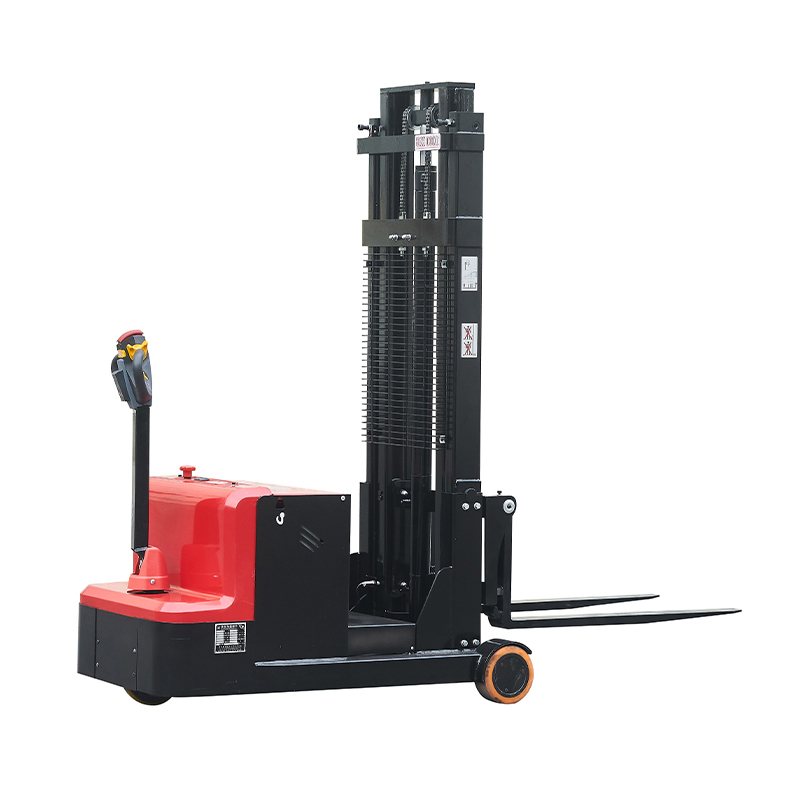
Equipment introduced: Electric Walkie Stacker Forklift
The first solution introduced was Electric Walkie Stacker Forklift systems.
Unlike traditional forklifts, walkie stackers:
- Operate in walk-behind mode
- Require less turning space
- Provide controlled vertical stacking
- Reduce aisle congestion significantly
Real operational change:
Before:
- Forklift enters aisle → blocks traffic → completes stacking → exits
After:
- Walkie stacker enters narrow aisle → performs lift → clears quickly
Measured improvement:
- Reduced aisle congestion during peak hours
- Increased rack utilization in previously inaccessible zones
- Lower collision risk in narrow storage areas
However, another issue remained unresolved: load balancing for medium-heavy operations.
Case 2: “We needed both lifting height and load stability”
Secondary problem after first upgrade
After introducing walkie stackers, warehouse efficiency improved, but a new limitation appeared:
- Certain pallets were too heavy for standard stackers
- Outdoor loading zones still required forklift-level stability
- Uneven floor conditions affected stacker performance
This led to partial reintroduction of forklift operations, which created system inconsistency.
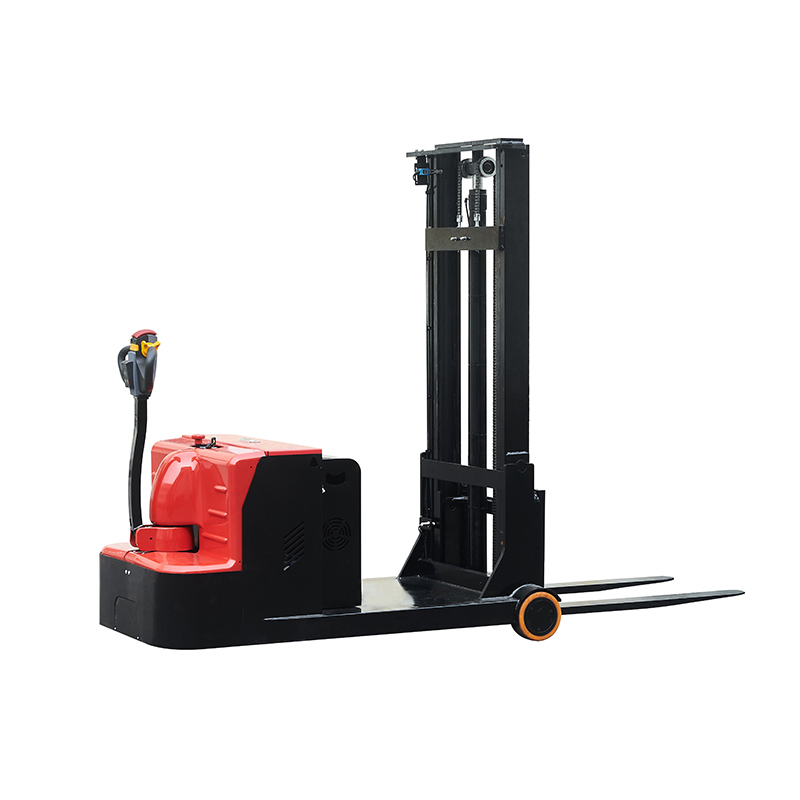
Equipment introduced: Walkie Counterbalance Forklifts
To solve this, Walkie Counterbalance Forklifts were introduced.
Unlike standard stackers, counterbalance models are designed with:
- Rear counterweight balancing system
- Higher load stability during lifting
- Better performance on mixed indoor/outdoor surfaces
Real operational advantage:
- No need for front support legs
- Can handle heavier pallet loads safely
- Works in semi-outdoor warehouse yards
- Provides forklift-level stability in compact format
Practical impact:
- Eliminated need for large forklift in internal zones
- Standardized heavy-load handling process
- Reduced equipment overlap in warehouse fleet
Key Engineering Insight: Why Walkie Systems Work Better in Mixed Warehouses
In real warehouse environments, efficiency problems are rarely caused by a single factor.
They are usually a combination of:
- Space limitation
- Load variation
- Workflow fragmentation
- Equipment mismatch
This is why combining Electric Walkie Stacker Forklift + Walkie Counterbalance Forklifts creates a more stable system than relying on forklifts alone.
System Behavior in Real Warehouse Flow
After implementation, warehouse operations typically stabilize into a layered handling system:
1. Receiving zone
Walkie counterbalance forklifts handle incoming heavy pallets.
2. Internal distribution
Electric walkie stackers transport goods into narrow aisle storage zones.
3. Vertical storage
Stackers place pallets into mid-to-high rack levels.
4. Picking and retrieval
Walkie stackers retrieve goods for outbound processing.
5. Dispatch zone
Counterbalance forklifts manage truck loading operations.
Why Electric Walkie Stacker Forklift Replaces Forklifts in Internal Zones
In medium warehouse systems, forklifts are often overused.
Common inefficiencies include:
- Forklifts performing short-distance repetitive transport
- Excessive fuel or battery consumption
- Unnecessary machine size for narrow aisle work
- Idle time caused by traffic congestion
Electric walkie stackers solve this by:
- Reducing equipment footprint
- Increasing aisle accessibility
- Improving cycle time for short-distance movement
In many real projects, forklifts are gradually restricted to:
- Outdoor handling
- Container loading
- Heavy-duty transport only
While walkie stackers take over 80% of internal warehouse movement tasks.
Walkie Counterbalance Forklifts in Real Deployment Logic
Walkie counterbalance forklifts are typically introduced when warehouses face a specific conflict:
need forklift-level load capacity + need compact operational footprint
This is common in:
- Medium-sized logistics hubs
- Manufacturing distribution warehouses
- Mixed indoor-outdoor facilities
Real decision logic:
- If load is heavy → counterbalance forklift
- If space is narrow → walkie stacker
- If both conditions exist → walkie counterbalance forklift system
This hybrid logic is why many warehouses are shifting away from single-equipment dependency.
Operational Comparison in Real Warehouse Use
Forklift-only system:
- High capacity
- High space consumption
- Low flexibility in narrow aisles
Walkie stacker system:
- High flexibility
- Medium load capacity
- Excellent for internal storage flow
Walkie counterbalance system:
- Balanced load capacity
- Compact footprint
- Suitable for mixed environments
Real Efficiency Gains Observed in Warehouse Projects
Across multiple warehouse optimization cases, improvements are usually not dramatic per machine—but cumulative across workflow:
- Reduced aisle congestion
- Faster pallet turnover
- Improved rack utilization rate
- Lower equipment idle time
- More stable shift performance
The most important observation is:
Efficiency gain comes from correct task separation, not stronger machines.
Procurement Insight: How Buyers Actually Evaluate These Systems
In real B2B purchasing behavior, buyers rarely search directly for “walkie stacker forklift” as a final decision.
They usually describe problems like:
- “forklift too big for narrow warehouse”
- “need compact stacking solution”
- “heavy pallet but small space”
- “warehouse aisles too tight for forklift”
Then map to equipment categories:
- Electric Walkie Stacker Forklift → space problem solution
- Walkie Counterbalance Forklifts → load + stability problem solution

 English
 русский
 Español
 عربى
عربى
 Português